Churches
Catedral de Ávila, the cathedral of the Saviour
Catedral de Ávila is the cathedral of the Diocese of Ávila, dedicated to the Saviour and begun around 1170 to a plan attributed to the master Fruchel. Its east end is built into the city wall as one of its turrets, and Spanish sources count it as the first Gothic cathedral in Spain.
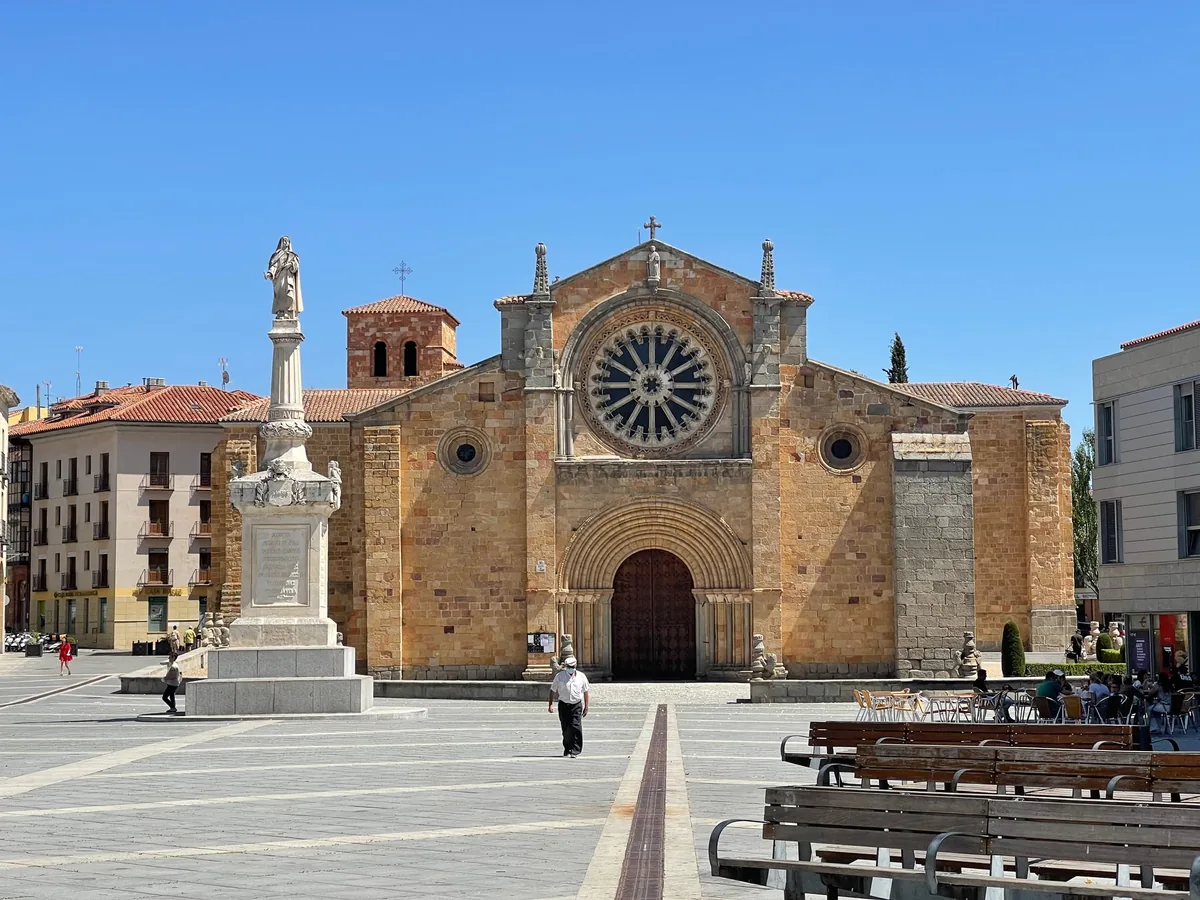
- Type
- Cathedral
- Dedication
- Christ the Saviour
- Rite
- Roman
- Diocese
- Diocese of Ávila
- Built
- 12th century, begun c. 1170
- Style
- Romanesque and Gothic
- Architects
- Giral Fruchel
- Website
- catedralavila.es
Two founding traditions
The Diocese of Ávila dates its restoration to the years after Alfonso VI took Toledo in 1085. Its own history records a bishop Sancho consecrated in 1121, his brother Íñigo in 1133, and a modest cathedral built in those years of which scant traces survive in the present church. The cathedral's history page credits Raymond of Burgundy, the king's son-in-law, with the city walls and the first church dedicated to the Saviour.
Two accounts exist of when the present church was begun. One holds that Alvar García started it in 1091 on the remains of an earlier church of the Saviour ruined in Muslim attacks. In that telling a king raised the money, Alfonso VI in the Spanish account and Alfonso VII in the English one. Most historians instead attribute the cathedral to the master Fruchel and date it to the twelfth century, and the cathedral itself gives a start around 1170 and more than 300 years of building.
Built into the city wall
Fruchel, who by the Spanish account directed the works from 1172 until his death in 1192, began at the east end with an ambulatory of nine chapels and a plan for five aisles. That east end is set into the city wall as one of its turrets, which gives the building its fortress character and its nickname Fortior Abulensis. The fortified apse is known as the cimorro, and its outside was faced in granite in 1595. Inside, the east end is built of a ferruginous sandstone from the Amblés valley called piedra sangrante, bleeding stone, after the red iron veins that run through its white ground.
After Fruchel's death the plan was reduced to three aisles, and the later masters built in granite and in the French Gothic manner of the Île-de-France. The Spanish sources call it the first Gothic cathedral in Spain, and the English Wikipedia article counts it with Cuenca as one of the first two, earlier than Burgos and León. Both articles note its resemblance to the abbey church of Saint-Denis. The finished church is 85 metres long and 42.5 metres wide, and its nave rises 28 metres over a width of only 10 metres.
Berruguete's retablo and the tomb of El Tostado
The retablo of the high altar was begun in 1499 by Pedro Berruguete, who set out the design and painted the predella with the four doctors of the Church and the four evangelists. He died in 1503, Bartolomé de Santa Cruz carried on with the Crucifixion, the Epiphany and the Transfiguration until his own death in 1508, and Juan de Borgoña finished the panels in 1512. The gilded frame was completed by Vasco de la Zarza in 1508, and the alabaster tabernacle is his too.
Behind the high altar, on the inner face of the ambulatory, five carved panels by Vasco de la Zarza frame the tomb of Alonso de Madrigal, called El Tostado, bishop of Ávila from 1449 to 1455. The central panel shows him in cope and mitre at his reading, eyes half closed, beneath reliefs of the Nativity and the journey of the Magi, with the seven virtues set around the tomb. The cathedral's own page counts that panel among the great works of Renaissance sculpture in Spain. The walnut choir stalls in the nave were begun in 1536 to the designs of Cornelius de Holanda and took eleven years, with Juan Rodríguez and Lucas Giraldo among the carvers.
The towers, the diocese, and the building today
The upper walls of the nave, the flying buttresses, the cloister and the sacristies belong to a third campaign from the late thirteenth to the mid fourteenth century under Bishop Sancho Blázquez Dávila. One tower of the west front was left unfinished for want of money. That south tower is still topped in brick because it never received a bell chamber, and it holds the bell-ringer's house, lived in by families of bell-ringers from the sixteenth century until the 1950s. The north tower holds ten bells and the clock, and visits to the bell-ringer's house are suspended while the towers are under restoration.
The cathedral is the seat of the Bishop of Ávila, and a chapter of canons under a dean, now styled president, is responsible for its most solemn liturgies. Mass is said at 09:00 from Monday to Saturday and at 11:00 on Sundays and holy days, and tourist visits stop during worship. The diocese keeps 14 July as the feast of the dedication of the cathedral, the anniversary of its consecration, observed across the diocese. The old town was declared a World Heritage Site in 1985, and since 2014 the cloister has held the tomb of Adolfo Suárez, prime minister from 1976 to 1981, and his wife Amparo Illana.
Sources
- Ávila Cathedral — Wikipedia (technical facts, the two founding accounts, the first-two-Gothic-cathedrals claim, and the 2014 burial)
- Catedral de Ávila — Wikipedia (Spanish. Fruchel from 1172 to 1192, the piedra sangrante and the cimorro, the first-Gothic-cathedral claim, and World Heritage in 1985)
- Historia — Catedral de Ávila, official website (Raymond of Burgundy, the start around 1170, Fruchel's east end in the wall, the third campaign, the unfinished tower, 1595, and the dimensions)
- Retablo del Altar Mayor — Catedral de Ávila, official website (Berruguete from 1499, Santa Cruz, Juan de Borgoña to 1512, and Vasco de la Zarza's frame)
- El Trasaltar — Catedral de Ávila, official website (the tomb of El Tostado, bishop 1449 to 1455)
- Coro y trascoro — Catedral de Ávila, official website (the choir stalls from 1536)
- La torre campanario de la Catedral de Ávila — Catedral de Ávila, official website (the unfinished south tower, the bell-ringer's house, and the north tower's ten bells)
- Visita — Catedral de Ávila, official website (tower visits suspended during restoration)
- Culto — Catedral de Ávila, official website (Mass times and the chapter)
- Tumba de Adolfo Suárez — Catedral de Ávila, official website (the tomb in the cloister)
- SAI Catedral del Salvador — Diócesis de Ávila (the bishop's seat and the chapter)
- Historia — Diócesis de Ávila (the restoration of the see after 1085, the bishops of 1121 and 1133, and the earlier modest cathedral)
- 14 de julio, fiesta de la dedicación de la Catedral — Diócesis de Ávila (the feast of the dedication on 14 July)
- Horario de misas, listado por templo — Diócesis de Ávila (Mass times)
Further reading
- The Cathedrals of Spain — John Harvey, Hastings House, 1957 (borrowable on the Internet Archive)
- Ávila — Encyclopaedia Britannica
- Old Town of Ávila with its Extra-Muros Churches — UNESCO World Heritage Centre