Churches
Cologne Cathedral and the Shrine of the Three Kings
Cologne Cathedral is the mother church of the Archdiocese of Cologne, dedicated to Saint Peter. Its foundation stone was laid in 1248 to house the bones that tradition venerates as the relics of the Magi, and its twin towers were finished to the medieval plan in 1880.
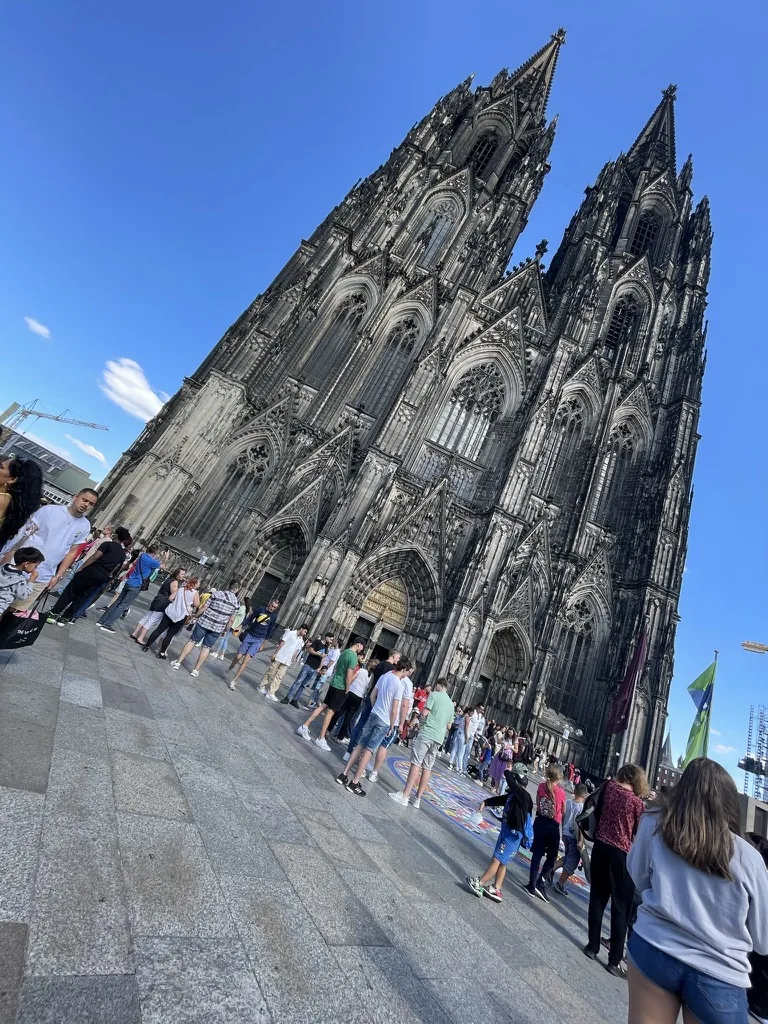
- Type
- Cathedral
- Dedication
- Saint Peter
- Rite
- Roman
- Diocese
- Archdiocese of Cologne
- Built
- 1248–1560 and 1842–1880
- Style
- Gothic
- Website
- www.koelner-dom.de/en
The relics from Milan
In 1164 Archbishop Rainald von Dassel brought to Cologne bones venerated as those of the Magi, the wise men of Matthew's gospel. The emperor Frederick Barbarossa had taken them from Milan two years earlier and gave them to the archbishop, who had served him on his Italian campaign. The cathedral's own account records that he received them at Pavia on 11 June 1164 and reached Cologne after 43 days on the road.
The bones were placed in the Carolingian cathedral that then stood on the site. Between the 1180s and the 1230s the goldsmith Nicholas of Verdun and his workshop made the Shrine of the Three Kings to hold them, a gilded reliquary in the shape of a basilica. Pilgrims came from across Europe, and the German kings, after their coronation at Aachen, usually went first to Cologne to venerate the Three Kings. Historians dispute who first identified the bones with the Magi, and when the shrine was opened in 1864 it was found to contain bones and garments.
Begun in 1248, abandoned in the sixteenth century
Archbishop Konrad von Hochstaden laid the foundation stone of the present church on 15 August 1248. The plan followed the newest French work, above all Amiens Cathedral, and of the first master, Gerhard, little more than the name is known. When the east end of the old cathedral was pulled down by fire, the flames spread and burned most of the building, but the shrine and the Gero Cross were carried out. Archbishop Heinrich von Virneburg consecrated the new choir on 27 September 1322, and the shrine was carried into it in procession.
Work ceased in the sixteenth century, after 1520 by the cathedral's own account, and did not resume for more than 300 years. A temporary wall closed the finished choir off from the unfinished nave. The south tower stood at 56 metres, about a third of its planned height, while the outer walls of the north tower were mostly only five metres high. On the stump of the south tower stood the medieval building crane, which stayed there until 1868 and served as the emblem of the city.
Completion to the medieval plan
The armies of the French Revolution occupied the Rhineland in 1794, and from 1796 the building served as a magazine and a camp for prisoners of war. It returned to church use as a parish church in 1803 and became a bishop's church again when the archdiocese was refounded in 1821. From 1822 a new cathedral workshop, the Dombauhütte, was set up to repair the medieval fabric, and it still employs about 100 people to keep the building in repair.
King Friedrich Wilhelm IV of Prussia laid the stone for the completion in 1842, and in the same year citizens of Cologne founded the Zentral-Dombau-Verein, which raised 60 per cent of the cost. The towers followed the medieval façade drawing of about 1280 to 1290, though the roofs and crossing tower of 1860 were built in iron. The finished church was celebrated on 15 October 1880, and at over 157 metres its towers made it the tallest building in the world. In 1996 it was added to the UNESCO World Heritage List.
War, repair, and the building today
In the Second World War the cathedral took 14 heavy high-explosive hits and more than 70 incendiary hits, and most of the vaults over the nave and transept fell. The organ and most of the nineteenth-century glass were lost, but the medieval windows and many furnishings had been removed in time. The Dombauhütte had the choir and transept usable for the 700th anniversary of the foundation stone in 1948 and the nave by 1956. The shrine came back through the ruined streets in procession in 1948 and has stood behind the high altar since.
The cathedral is the seat of the Archbishop of Cologne, and its chapter of canons is responsible for the liturgy inside it. Mass is celebrated five times a day, and the north transept is open without charge for prayer, though tourist visits have required a ticket since 1 July 2026. Since 2006 the chapter has held a pilgrimage each year around 27 September, the anniversary of the choir's consecration, called the Dreikönigswallfahrt since 2019. Every service during those days ends with a procession that passes beneath the shrine, so the church begun to house the relics still gathers its pilgrims under them.
Sources
- Kölner Dom — Hohe Domkirche Köln
- Geschichte — Hohe Domkirche Köln (building history from 1164 to the post-war repair)
- Der Weg der Heiligen Drei Könige — Hohe Domkirche Köln (the 1164 translation, the shrine, and its return in 1948)
- Dreikönigswallfahrt — Hohe Domkirche Köln (the annual pilgrimage and its processions)
- Dombauhütte Köln — Hohe Domkirche Köln, Dombauhütte (the workshop today)
- Solemnity of Saints Peter and Paul, Apostles: Mass during the Day — USCCB Daily Readings (lectionary 591)
- Cologne Cathedral — Wikipedia (technical facts)
Further reading
- Cologne Cathedral: its history, its works of art — Arnold Wolff, Greven, 2003 (borrowable on the Internet Archive)
- Cologne Cathedral — Encyclopaedia Britannica
- Cologne Cathedral — UNESCO World Heritage Centre