Churches
Milan Cathedral and the Fabbrica that still builds it
Milan Cathedral is the seat of the Archbishop of Milan and the mother church of the Ambrosian diocese, dedicated to the Nativity of Mary. Work began in 1386 on the site of two earlier basilicas, and the last of its doors was fitted in 1965.
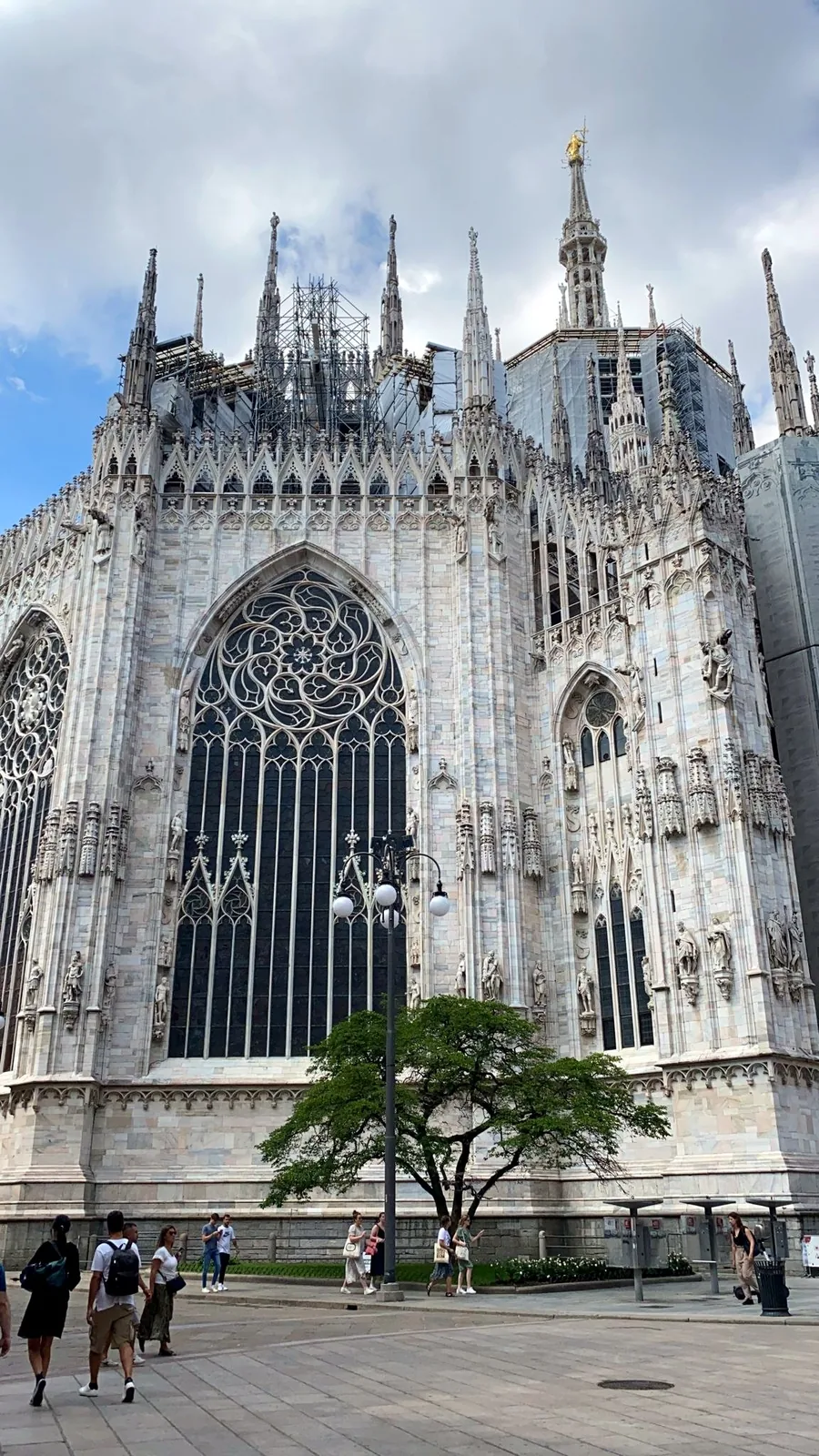
- Type
- Cathedral
- Dedication
- Nativity of the Blessed Virgin Mary
- Rite
- Ambrosian
- Diocese
- Archdiocese of Milan
- Built
- 1386–1965
- Style
- Gothic
- Architects
- Simone da Orsenigo
- Website
- www.duomomilano.it/en
Two basilicas and a baptistery
The cathedral occupies the most central site of Roman Mediolanum, where the public basilica faced the forum. Two churches stood there before it. Santa Tecla, completed by 355, served as the summer basilica, and from the ninth century Santa Maria Maggiore beside it served as the winter basilica. Between them stood the baptistery of San Giovanni alle Fonti, built in 378, where by tradition Ambrose baptised Augustine in 387.
The new cathedral took the ground of all three. Santa Maria Maggiore was worked as a stone quarry for the new building, and the baptistery was demolished and buried from about 1386. Their remains lie under the cathedral's forecourt and can be visited in the Archaeological Area, where the octagonal font of the baptistery is still visible.
The Fabbrica and the Candoglia marble
Archbishop Antonio da Saluzzo began construction in 1386, in the same years that his cousin Gian Galeazzo Visconti took power in Milan. In October 1387 Gian Galeazzo founded the Veneranda Fabbrica del Duomo, the body that has run the building site ever since. The first chief engineer, Simone da Orsenigo, had planned a brick church in the Lombard manner. The lord chose marble and the Gothic of northern Europe instead, and the Fabbrica brought in engineers and masons from across the continent.
On 24 October 1387 Gian Galeazzo ceded the Candoglia quarry, at the mouth of the Ossola valley in Piedmont, to the Fabbrica, with free carriage of the stone to Milan by water. Blocks travelled down the Toce, across Lake Maggiore, along the Ticino and the Naviglio Grande to a small lake a few hundred metres from the site. Water transport continued until 1920. Pope Martin V consecrated the high altar on 16 October 1418, and Carlo Borromeo consecrated the whole church in 1577.
Six centuries of building
Work began at the apse and moved west. After Gian Galeazzo died in 1402 it slowed for want of money, and the octagonal crossing tower was only finished between 1500 and 1510, after a competition in 1488 that drew models from Leonardo da Vinci and Bramante. Foundations for a façade were laid early in the seventeenth century, but the old front of Santa Maria Maggiore stood before it until the 1680s. On 21 June 1762 the Fabbrica's architect Francesco Croce was commissioned to build the great spire over the crossing, which reaches 108.5 metres.
Giuseppe Perego's gilded copper statue of the Virgin, the Madonnina, 4.16 metres tall, was finished in 1773 and raised to the top of that spire in the last days of December 1774 without ceremony. On 20 May 1805 Napoleon, about to be crowned King of Italy in the cathedral, ordered the façade completed, and the work ran from 1807 to 1813. Most of the spires followed in the nineteenth century. The doors came last, fitted between 1909 and 1965, and the final one was inaugurated on 6 January 1965.
The roof is open to visitors, who walk among the spires and flying buttresses at the height of the vaults. The Fabbrica still keeps a working site on the south flank, restoring stone and replacing carved pieces from its own marble yard, and it maintains the quarry at Candoglia. In August 1939 the Madonnina was wrapped in grey-green cloth against bombers, and Cardinal Schuster uncovered it on 6 May 1945. By tradition no building in Milan rises above the statue, so replicas of it have been placed on the city's taller towers.
The Holy Nail, the Ambrosian Church and the feast
High in the vault above the altar a red lamp marks the tabernacle of the Holy Nail, a relic believed to be one of the nails of the Crucifixion. It has been in the cathedral since 20 March 1461, when it was carried across from Santa Tecla. On the days nearest 14 September, the feast of the Exaltation of the Cross, the archbishop rises to the tabernacle in a cloud-shaped lift called the Nivola. He brings the relic down for a three-day exposition, a rite that Carlo Borromeo began.
The cathedral is the mother church of the Diocese of Milan and holds the chair of its archbishop, Mario Delpini since 2017. The diocese keeps the Ambrosian liturgy, and the Fabbrica describes the building as the visible sign of the Ambrosian Church gathered around its bishop. Its patronal feast is the Nativity of Mary on 8 September, when the archbishop's pontifical Mass opens the diocese's pastoral year and vespers close with a procession in her honour. The Fabbrica says it has entrusted the work to Mary's protection since 1387.
Sources
- Duomo di Milano — Veneranda Fabbrica del Duomo di Milano
- The Cathedral — Veneranda Fabbrica del Duomo di Milano (foundation of the Fabbrica, 1418 altar, façade and doors)
- The Candoglia Quarry — Veneranda Fabbrica del Duomo di Milano (the 1387 grant and the water route)
- Archaeological Area — Veneranda Fabbrica del Duomo di Milano (Santa Tecla, Santa Maria Maggiore and the baptistery)
- The Madonnina — Veneranda Fabbrica del Duomo di Milano (the spire, the statue and its wartime covering)
- Triduum of the Holy Nail and Rite of the Nivola — Veneranda Fabbrica del Duomo di Milano (the relic since 1461 and the Nivola)
- Solemnity of the Nativity of the Blessed Virgin Mary — Veneranda Fabbrica del Duomo di Milano (the patronal feast and the pastoral year)
- The Archbishop — Veneranda Fabbrica del Duomo di Milano (the cathedral as mother church and seat of the Ambrosian Church)
- Feast of the Nativity of the Blessed Virgin Mary — USCCB Daily Readings (lectionary 636)
- Milan Cathedral — Wikipedia (technical facts and construction chronology)
- Madonnina (statue) — Wikipedia (the replicas on taller buildings)
Further reading
- The Duomo: art, faith, history of the cathedral of Milan — Ernesto Brivio, Veneranda Fabbrica del Duomo di Milano, 2003 (borrowable on the Internet Archive)
- Milan Cathedral — Encyclopaedia Britannica