Churches
Mont-Saint-Michel Abbey, the sanctuary of the archangel in the bay
Mont-Saint-Michel Abbey stands on a rocky island in the bay off the coast of Normandy and is dedicated to the archangel Michael. Its own tradition dates the first sanctuary to 708, Benedictine monks arrived in 966, and the buildings have belonged to the French state since the Revolution. Since 2001 the Monastic Fraternities of Jerusalem have lived in the abbey.
- Type
- Abbey church
- Dedication
- Saint Michael the Archangel
- Rite
- Roman
- Served by
- Benedictines, from 966
- Built
- 10th century onward
- Style
- Romanesque and Gothic
Aubert's oratory and the Benedictines, 708 to 966
The abbey's own account of its origin comes from the Revelatio ecclesiae sancti Michaelis, a Latin text of the ninth century. It tells that in 708 the archangel Michael appeared three times in a dream to Aubert, bishop of Avranches, and asked for a sanctuary on the island then called Mont Tombe. The oratory echoed the archangel's earlier sanctuary on Monte Gargano in Puglia. The Centre des monuments nationaux presents the story as legend, and a skull kept at the basilica of Saint-Gervais in Avranches bears a mark that tradition attributes to the archangel's finger.
In 966 Duke Richard I of Normandy replaced the community living on the rock with Benedictine monks under Abbot Maynard, who came from the abbey of Saint-Wandrille. That year is counted as the foundation of the abbey, and the monks built the double-naved church of Notre-Dame-sous-Terre, which now lies under the nave. Pilgrims came to ask Saint Michael for protection, and the monks produced and kept manuscripts, two hundred of which are now preserved in Avranches.
The abbey church and the Merveille
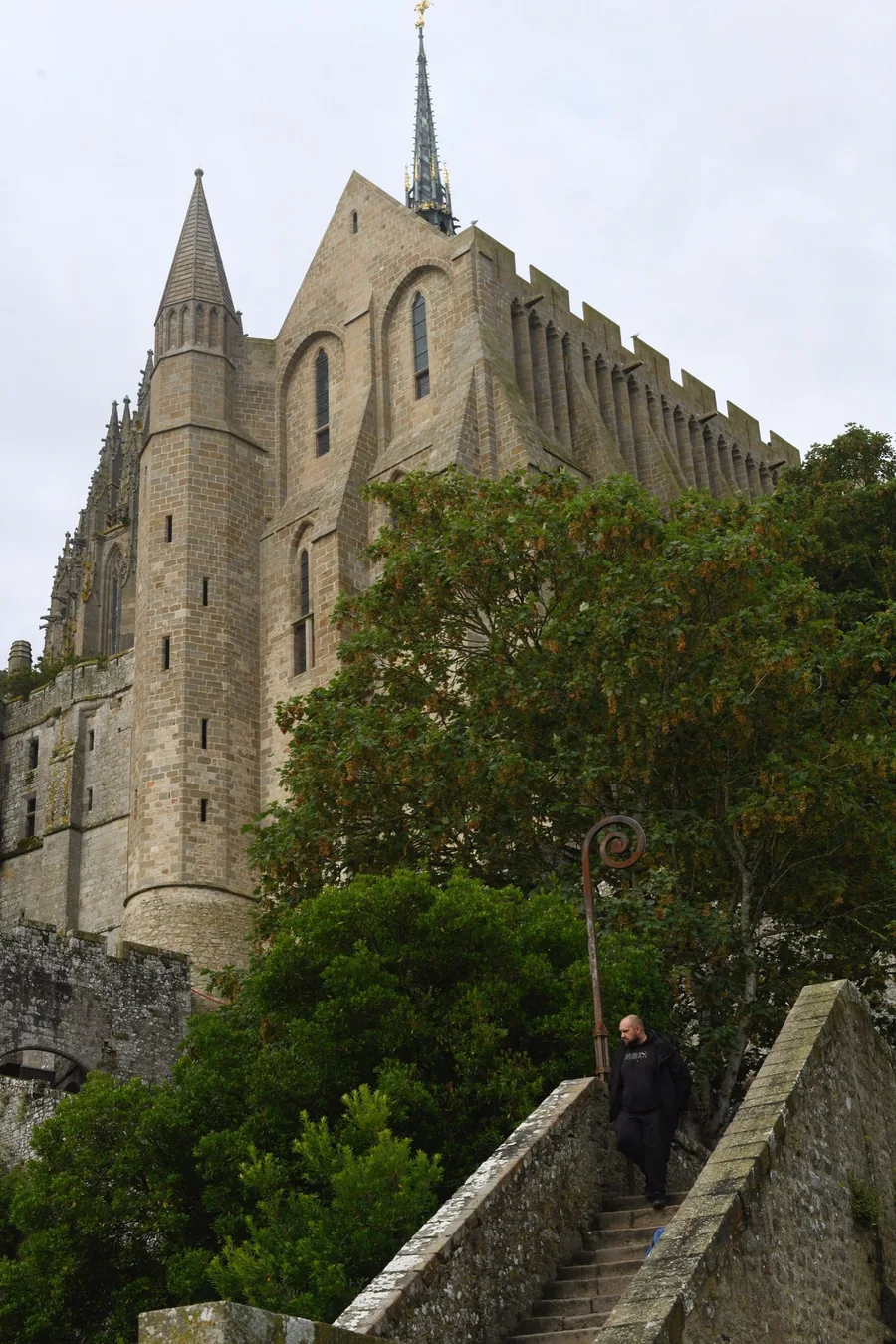
The Romanesque abbey church was begun in 1023, according to the tradition the monument's managers cite, on the summit of the rock, and it rests partly on four crypts built on the slope. The nave rises in three tiers of arcades, galleries and high windows under a timber roof. Abbot Robert de Torigni added a hostelry, an infirmary and other buildings on the west and south-west between 1154 and 1164. Three bays at the west end of the nave were pulled down after a fire in 1776, and the present classical front followed in the 1780s.
The Merveille is the group of Gothic buildings on the north side of the rock, built in the early thirteenth century in three levels. Its east block, raised from 1211 to 1218, stacks the almshouse where the poor were received, the guests' hall and the refectory. The west block, finished in 1228, stacks the cellar, the knights' hall and the cloister, whose 137 columns stand in staggered rows. A chapter house was planned beyond the cloister and never built.
Siege, prison and classification
During the Hundred Years' War the abbey served as a fortress of the duchy of Normandy, and Abbot Pierre le Roy added towers and a fortified residence between 1386 and 1410. In 1393 two turrets were added to flank the gate of 1257. The English besieged the Mount from 1423 and withdrew defeated in 1434, and two bombards they left behind still stand near a gate of the town walls. The Romanesque choir collapsed in 1421, and its Flamboyant Gothic replacement was built from 1446 to 1523 over a crypt of great pillars.
Pilgrimage declined after the Reformation, and by the seventeenth century the monks were already receiving prisoners sent by lettre de cachet. The abbey was closed in 1791 and turned into a prison, holding up to 300 priests at one point and later political prisoners including Armand Barbès and Auguste Blanqui. A campaign joined by Victor Hugo led Napoleon III to close the prison in 1863, when 650 prisoners were moved elsewhere. The abbey was classified as a historic monument in 1874, and Édouard Corroyer began the restoration, capped by a neo-Gothic spire in 1897 with Emmanuel Frémiet's gilded statue of the archangel.
A state monument with a community in residence
The abbey belongs to the French state and is managed by the Centre des monuments nationaux, which sells tickets to all its rooms and closes only on 1 January, 1 May and 25 December. Worship resumed in 1922, a small Benedictine community settled after the monastic millennium celebrations of 1965 and 1966, and in 2001 the Monastic Fraternities of Jerusalem replaced them. About a dozen monks and nuns now live in the former abbots' quarters, which also house the monument's administration, and religious services continue inside the monument.
Mont-Saint-Michel and its bay were inscribed on the UNESCO World Heritage List in 1979. At spring tides the sea surrounds the rock after retreating up to 15 km at low water, and the tidal bore advances at about 6 km an hour. A dam on the Couesnon, begun in 2009, and a bridge by Dietmar Feichtinger that opened in July 2014 replaced the raised causeway of 1879 so that water flows freely around the island. On 21 March 2015 a spring tide covered the new bridge. The abbey keeps the feast of Saint Michael, with Gabriel and Raphael, on 29 September.
Sources
- Mont-Saint-Michel Abbey — Wikipedia (technical facts, the Revelatio, 966, the Merveille's dates and levels, the fortifications of 1386 to 1410, the prison and the restoration)
- History of the monument — Centre des monuments nationaux, abbaye du Mont-Saint-Michel (the legend of 708, 966, 1023, the siege of 1423 to 1434, the 1421 collapse, the prison, 1874, 1979 and the community since 2001)
- Finding your way around the monument — Centre des monuments nationaux, abbaye du Mont-Saint-Michel (the abbey church, the crypts, the Merveille's rooms, the abbots' quarters and the manuscripts in Avranches)
- The abbey church — Centre des monuments nationaux, abbaye du Mont-Saint-Michel (the church on the summit and its four crypts)
- The cloister, between sky and sea — Centre des monuments nationaux, abbaye du Mont-Saint-Michel (the Merveille's three levels, the 137 columns and the unbuilt chapter house)
- The high tides — Centre des monuments nationaux, abbaye du Mont-Saint-Michel (the spring tides, the 15 km retreat and the tidal bore)
- Practical information — Centre des monuments nationaux, abbaye du Mont-Saint-Michel (tickets and closing days)
- Mont-Saint-Michel — Wikipedia (the causeway of 1879, the dam begun in 2009, the bridge of 2014 and the tide of 21 March 2015)
- Feast of Saints Michael, Gabriel, and Raphael, Archangels — USCCB Daily Readings (lectionary 647)
Further reading
- Wonderful Mont Saint-Michel — Lucien Bély, Ouest-France, 1986 (borrowable on the Internet Archive)
- Mont-Saint-Michel — Encyclopaedia Britannica
- Mont-Saint-Michel and its Bay — UNESCO World Heritage Centre