Churches
Notre-Dame de Paris, the cathedral of Our Lady
Notre-Dame is the cathedral of the Archdiocese of Paris, begun in 1163 on the Île de la Cité and dedicated to the Virgin Mary. A fire on 15 April 2019 destroyed its roof and spire, and the building reopened for worship on 7 December 2024.
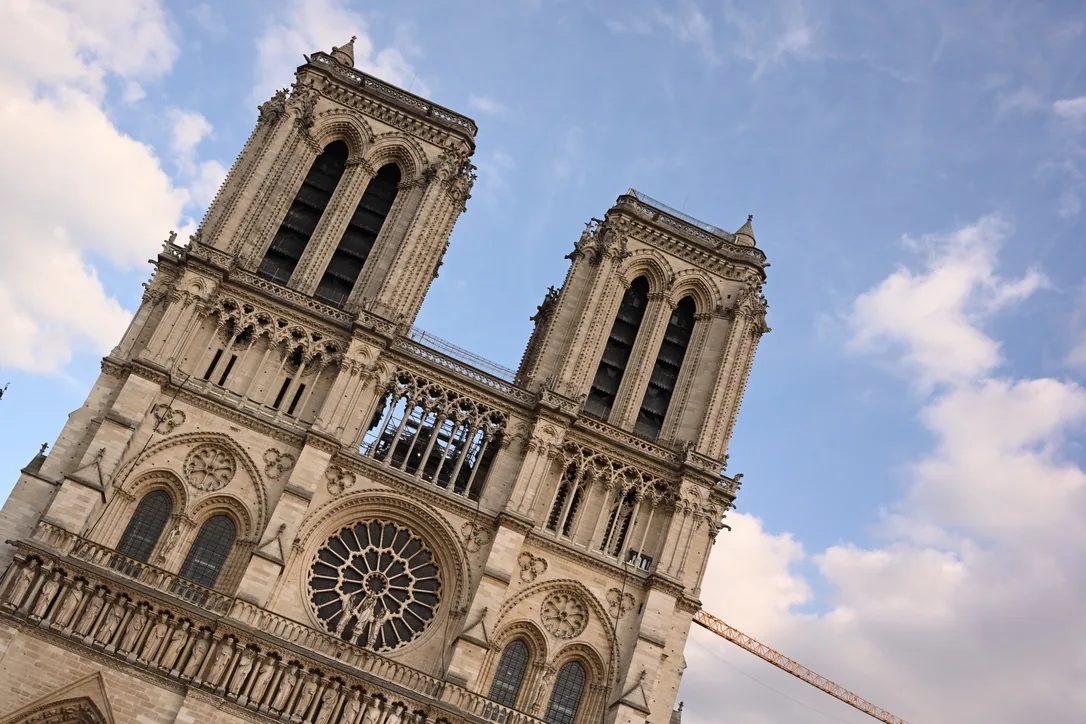
- Type
- Cathedral
- Dedication
- Our Lady
- Rite
- Roman
- Diocese
- Archdiocese of Paris
- Built
- 1163–1345
- Style
- French Gothic
- Website
- www.notredamedeparis.fr
Maurice de Sully's cathedral, 1163 onward
In 1160 Bishop Maurice de Sully decided to replace the earlier cathedral of Saint-Étienne with a much larger church in the style first tried at the royal abbey of Saint-Denis. The first stone was laid in 1163, and the chronicler Jean de Saint-Victor places the ceremony in the presence of King Louis VII and Pope Alexander III. The name of the first architect is not recorded.
The choir came first, and its high altar was consecrated on 19 May 1182. Maurice died in 1196, and his successor Eudes de Sully carried the nave close to completion by his own death in 1208. The west front was finished around the mid-1240s, the towers rose between 1225 and 1250, and from the late 1240s Jean de Chelles and Pierre de Montreuil rebuilt the transept ends with their rose windows. The cathedral's own history pages give the building as 127 metres long, 40 metres wide and 33 metres high.
Who owns it and who uses it
Notre-Dame is the seat of the archbishop of Paris, and the archdiocese celebrates Mass and the daily offices in it. Since the Revolution the building has belonged to the French state. It was nationalised on 2 November 1789, turned into a Temple of Reason in 1793, and returned to the Church for worship, though not in ownership, under the Concordat of 1801.
The law of 1905 on the separation of Church and state confirmed that arrangement. The Church holds the exclusive right to use the cathedral for worship in perpetuity, the state maintains the fabric, and the archdiocese pays for staff, security, heating and cleaning and keeps entry free of charge. In 1805 Pope Pius VII gave the cathedral the honorary rank of minor basilica.
The fire of 2019 and the reopening
On 15 April 2019 a fire broke out in the attic at 18:18 and spread through the oak roof frame known as the forest. The nineteenth-century spire collapsed at 19:50, bringing down 750 tonnes of stone and lead, and about 500 firefighters had the fire under control by 21:45. The façade, the towers, the walls, the buttresses and the three rose windows survived, and the stone vaults held apart from several holes.
A thousand oaks were selected in 2021 for the new roof frame. The new spire was put in place on 16 December 2023, topped by a gilded cockerel holding relics and the names of two thousand people who worked on the rebuilding. The cathedral reopened on 7 December 2024 in a ceremony presided over by Archbishop Laurent Ulrich, and the Crown of Thorns returned to the building on 13 December.
The Crown of Thorns and the feast of Our Lady
The cathedral treasury holds three relics that tradition identifies with the Passion: the Crown of Thorns, a fragment of wood from the cross, and a nail. King Louis IX bought the crown from the Latin emperor Baldwin II in 1238, carried it barefoot to Notre-Dame on 19 August 1239, and built the Sainte-Chapelle to house it. After the Revolution the relics passed to the archbishop of Paris and were placed in the cathedral treasury on 10 August 1806.
The crown is a circle of rushes bound with gold threads, with no thorns remaining, and since 1896 it has been kept in a tube of crystal and gold. It is offered for veneration on the first Friday of each month between 3 pm and 5 pm and displayed every Friday afternoon. The cathedral is dedicated to the Virgin Mary, and it celebrates the Solemnity of the Assumption on 15 August with Vespers and Mass on the evening before.
Sources
- Notre-Dame de Paris — Wikipedia (technical facts, construction chronology, ownership, the 2019 fire and the 2024 reopening)
- The Builders — Notre-Dame de Paris, official website (Maurice de Sully, 1160 and 1163, and the building's dimensions)
- Saint Louis and the Relics of the Passion — Notre-Dame de Paris, official website (the relics, 1238 to 1239, and the treasury since 1806)
- Veneration of the Holy Crown of Thorns — Notre-Dame de Paris, official website (veneration schedule)
- Notre-Dame de Paris, official website — Notre-Dame de Paris (free admission and the Assumption celebrated on 15 August)
- Solemnity of the Assumption of the Blessed Virgin Mary: Mass during the Day — USCCB Daily Readings (lectionary 622)
Further reading
- Notre-Dame of Paris — Allan Temko, W. W. Norton, 1994 (borrowable on the Internet Archive)
- Notre-Dame de Paris — Encyclopaedia Britannica
- Paris, Banks of the Seine — UNESCO World Heritage Centre