Churches
The Pantheon as a church: Santa Maria ad Martyres
The Pantheon was completed under the emperor Hadrian around AD 126 and consecrated as a church dedicated to Saint Mary and the Martyrs on a date traditionally given as 13 May 609. Continuous use is the usual explanation for why it survives almost intact.
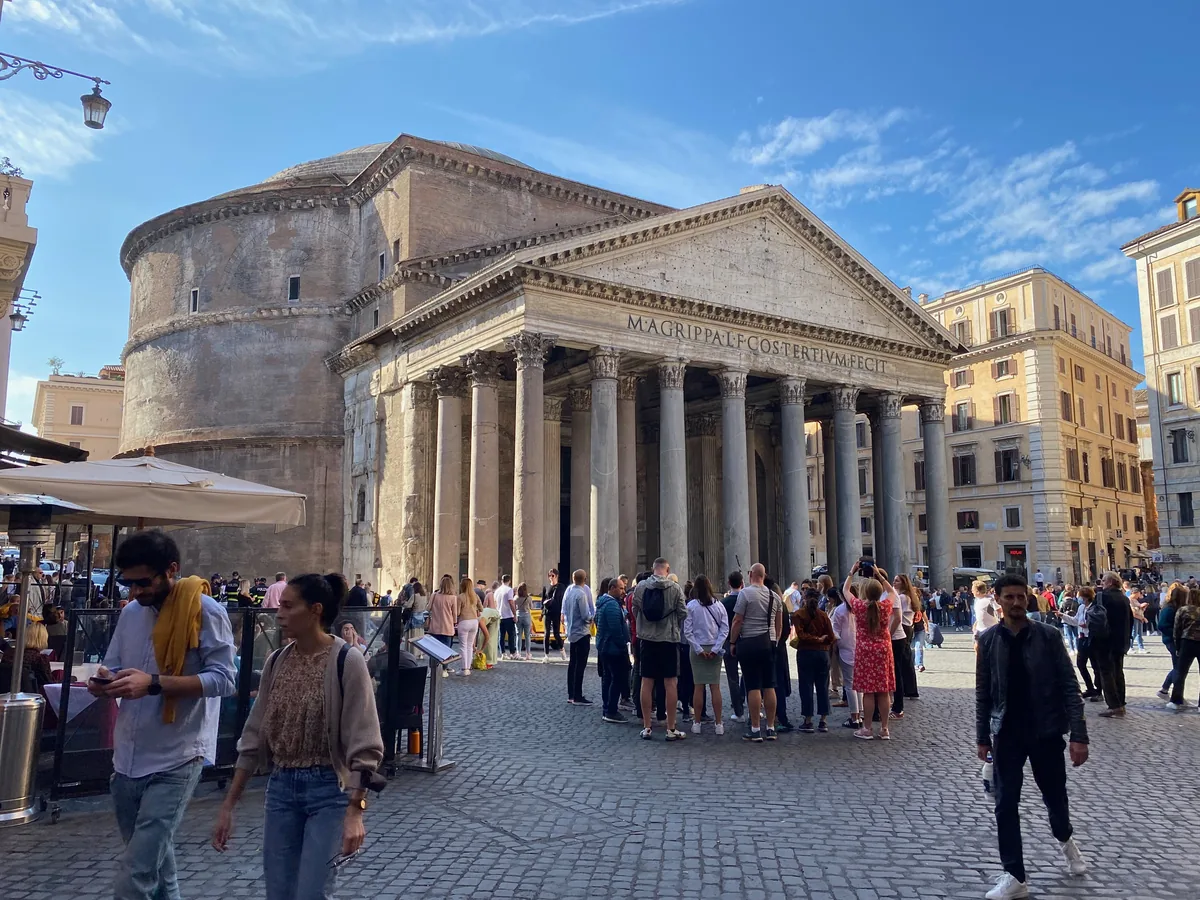
- Type
- Minor basilica
- Dedication
- Saint Mary and the Martyrs
- Rite
- Roman
- Diocese
- Diocese of Rome
- Built
- completed c. AD 126, under Hadrian
- Consecrated
- AD 609, as a church
- Style
- Roman
- Website
- www.pantheonroma.com
Agrippa's temple and Hadrian's rebuilding
Marcus Agrippa built the first Pantheon between 29 and 19 BC as part of a complex on his own land in the Campus Martius. Agrippa's temple burned in AD 80, and Domitian's replacement burned in 110. Hadrian completed the present building and probably dedicated it around 126, keeping Agrippa's name on the inscription across the porch. That reused inscription misled readers for centuries about who built what stands today.
Behind the porch a vestibule opens into the rotunda, roofed by a coffered concrete dome with a round opening to the sky. The height to the oculus and the diameter of the interior are the same, 43 metres. It remains the largest unreinforced concrete dome ever built.
A church since 609
In 609 the Byzantine emperor Phocas gave the building to Pope Boniface IV, who consecrated it as a church on 13 May 609. Bede, writing in the next century, records that the pope purified the temple of all the gods and dedicated it to the holy Mother of God and to all Christ's martyrs. The saints, he wrote, were to have a perpetual memorial where the company of devils had been expelled.
The church became known as Santa Maria Rotonda. A belfry was added over the porch gable in 1270. In the seventeenth century Pope Urban VIII stripped the bronze trusses from the portico and melted them down, prompting the Roman pasquinade that what the barbarians had not done, the Barberini did. The twin bell towers added in his reign were removed in the late nineteenth century.
Tombs and the building today
The painters Raphael and Annibale Carracci, the composer Arcangelo Corelli, and the architect Baldassare Peruzzi are buried here. So are the first two kings of united Italy, Victor Emmanuel II and Umberto I, with Umberto's queen, Margherita.
The Pantheon is a minor basilica and a rectory church of the Diocese of Rome, and Mass is still celebrated in it. The building itself is state property, administered by Italy's culture ministry.
Sources
- Ecclesiastical History of the English People, Book II, chapter 4 — Bede, translation at the Christian Classics Ethereal Library (the consecration under Boniface IV)
- Pantheon, Rome — Wikipedia (building history and burials)
Further reading
- The Pantheon: design, meaning, and progeny — William L. MacDonald, Harvard University Press, 1976 (borrowable on the Internet Archive)
- Pantheon — Encyclopaedia Britannica