Churches
St. Peter's Basilica and the grave beneath its altar
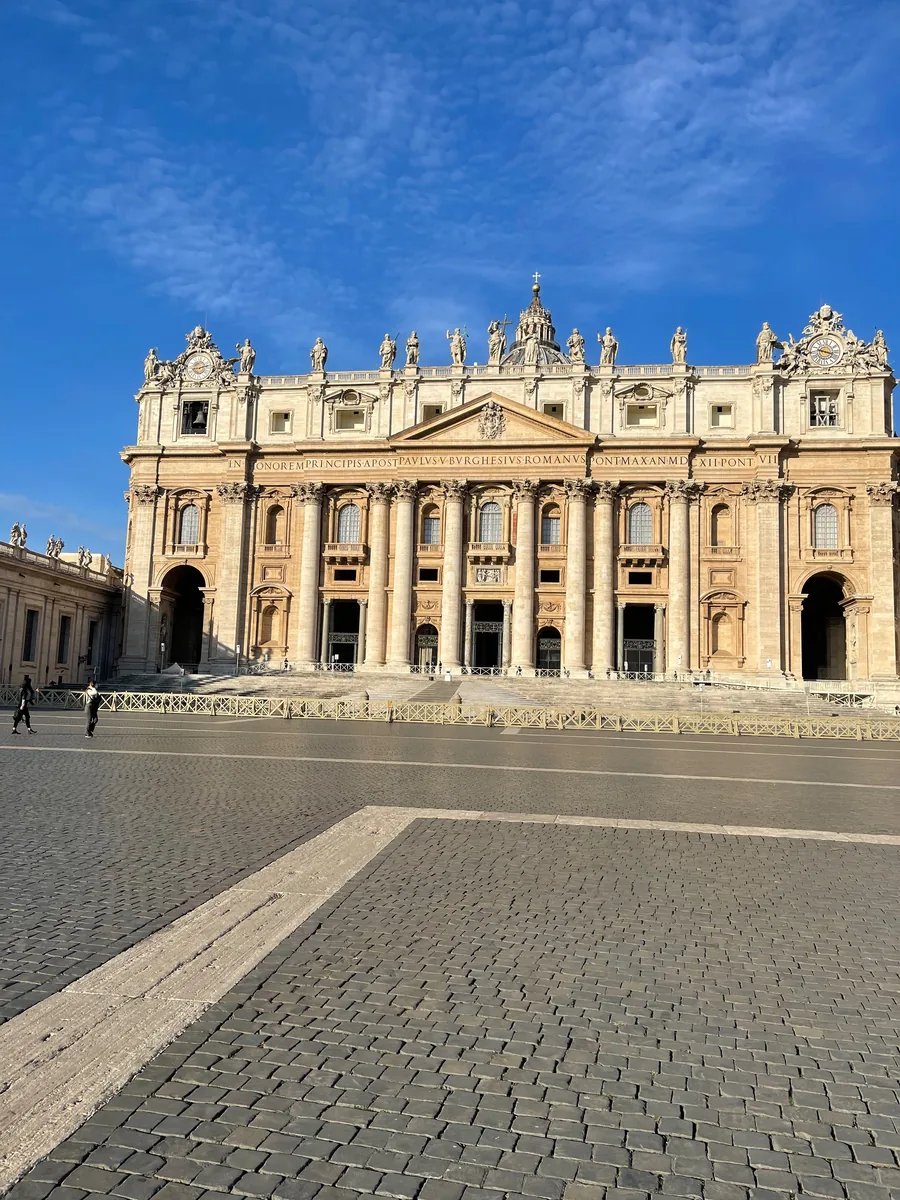
St. Peter's is the papal basilica of Vatican City, built between 1506 and 1626 over the fourth-century church of Constantine. Beneath both lies a Roman cemetery holding the shrine that the Church identifies as the grave of the apostle Peter.
- Type
- Papal basilica
- Dedication
- Saint Peter the Apostle
- Rite
- Roman
- Built
- 1506–1626
- Consecrated
- 1626
- Style
- Renaissance and Baroque
- Architects
- Donato Bramante, Michelangelo, Carlo Maderno, Gian Lorenzo Bernini
- Website
- www.basilicasanpietro.va/en
The old basilica
The emperor Constantine began a basilica on the Vatican hill between 319 and 333. It was over 103 metres long, with a large colonnaded atrium in front of the entrance, and its altar was set above a small shrine in a cemetery that Christians had venerated as Peter's burial place.
That building stood for more than eleven centuries. By the fifteenth century it was failing, and Pope Nicholas V planned repairs and modifications. Pope Julius II decided instead to replace it, which meant demolishing the old basilica in stages while a new one rose around it.
Rebuilding, 1506 to 1626
The foundation stone of the present church was laid on 18 April 1506 to a design by Donato Bramante. The work passed through a long line of popes and architects. On 1 January 1547 Michelangelo, then in his seventies, took over as superintendent and redesigned the dome. Giacomo della Porta and Domenico Fontana brought that dome to completion in 1590.
In 1607 a committee of architects decided to extend Michelangelo's centralised plan into a nave. Carlo Maderno's nave was begun on 7 May 1607 and his travertine façade followed. Pope Urban VIII dedicated the finished basilica on 18 November 1626, one hundred and twenty years after the first stone. Gian Lorenzo Bernini later added the bronze baldachin over the papal altar and the colonnades that enclose the square.
The excavations under the altar
In 1939, under Pope Pius XII, ten years of archaeological work began beneath the crypt, in ground that had been inaccessible since the ninth century. The digging uncovered a Roman necropolis and, directly under the high altar, the small shrine over which Constantine had centred his church.
On 23 December 1950 Pius XII announced in a radio broadcast that the tomb of Saint Peter had been found. He also said that none of the bones recovered there could be confirmed as Peter's. The Fabbrica di San Pietro, which maintains the building, still presents the site of that tomb as the point of origin of the basilica and of the life of the Roman Church. The necropolis can be visited by reservation through the Fabbrica's excavations office.
What the building is for
St. Peter's is a papal basilica and a place of pilgrimage. The pope presides at major liturgies inside it and in the square through the year. It has the largest church interior in the world and was never a parish church.
The altar, the dome, and the excavations all centre on one grave, and on the Church's claim about whose grave it is.
Sources
- Visit St. Peter's Basilica — Fabbrica di San Pietro (the tomb as the basilica's point of origin)
- The Necropolis — Fabbrica di San Pietro, Excavations Office
- Solemnity of Saints Peter and Paul, Apostles: Mass during the Day — USCCB Daily Readings (lectionary 591)
- Saint Peter's tomb — Wikipedia (the 1950 statement on the bones)
- St. Peter's Basilica — Wikipedia (construction chronology)
Further reading
- Saint Peter's: the story of Saint Peter's Basilica in Rome — James Lees-Milne, Little, Brown, 1967 (borrowable on the Internet Archive)
- St. Peter's Basilica — Encyclopaedia Britannica