Churches
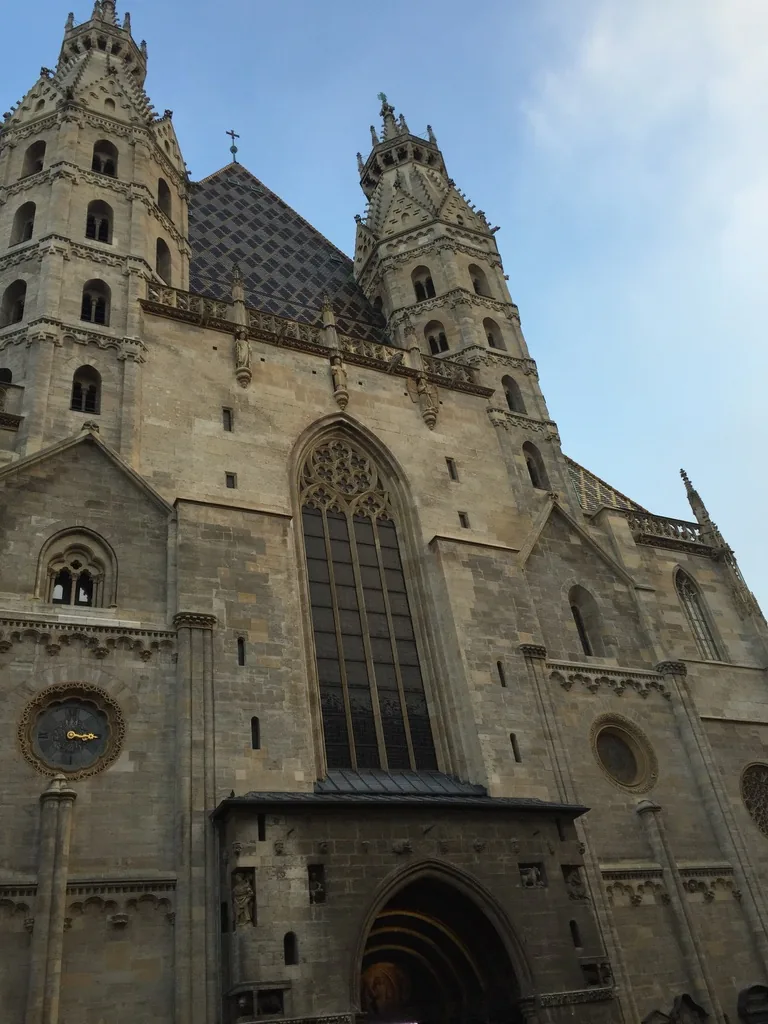
St. Stephen's Cathedral, the Stephansdom of Vienna
St. Stephen's Cathedral is the mother church of the Archdiocese of Vienna and the seat of its archbishop, dedicated to Saint Stephen, the first martyr. It began as a parish church named in the Treaty of Mautern of 1137, its south tower was finished in 1433, and after the fire of 12 April 1945 it reopened in April 1952.
- Type
- Cathedral
- Dedication
- Saint Stephen
- Rite
- Roman
- Diocese
- Archdiocese of Vienna
- Built
- 1137, Gothic rebuilding from the 14th century
- Style
- Romanesque and Gothic
- Website
- www.stephanskirche.at
The Treaty of Mautern and the Romanesque church
In 1137 Bishop Reginmar of Passau and Leopold IV of Austria signed the Treaty of Mautern, an exchange of lands that names the church and parish of St. Stephen for the first time. The cathedral's own history takes that year as the start of building, and the first Romanesque church was consecrated in 1147, probably before it was finished. It stood outside the oldest city wall, and Conrad III and Bishop Otto of Freising attended the consecration on their way to the Second Crusade.
The west front that faces Stephansplatz today belongs to a second Romanesque church, and its Giant's Door and two Heathen Towers are the oldest parts of the building. The Riesentor is the main entrance, with Christ in its tympanum. The Heidentürme beside it stand about 65 metres high, square at the base and octagonal above the roofline, and take their name from the Roman rubble said to have been reused in them. A fire in 1258 damaged the church, and the cathedral's own history reads its reconsecration on 23 April 1263 as a sign the damage was slight, an anniversary still marked by three minutes of the Pummerin bell.
Rudolf IV and the Gothic rebuilding
Work on a Gothic choir east of the Romanesque church began in 1304, and Bishop Albert of Passau consecrated it on 23 April 1340 under the name that survives, the Albertine choir, after Duke Albert II. His son Rudolf IV, born on All Saints' Day 1339 and known as the Founder, laid the cornerstone of a Gothic extension westward on 7 April 1359 near the present south tower. In 1365 he founded a chapter of canons at what was still a parish church. Vienna became a diocese only on 18 January 1469, when Emperor Frederick III obtained a bull from Pope Paul II, and the see became an archdiocese under Pope Innocent XIII in 1722.
The new nave grew around the old church, whose walls were taken down from inside in 1430, and the nave was vaulted between 1446 and 1474. The south tower, the Stephansturm that the Viennese call the Steffl, was completed in 1433 under the master builder Hans Prachatitz and stands 136.4 metres high with its crown. Foundations for a matching north tower were laid in 1450 under Frederick III, but work stopped in 1511, the year cut into its last course of stones, and in 1578 the stump received a Renaissance cap. It is 68.3 metres high, about half the height of the south tower, and the cathedral names it the Adlerturm, the Eagle Tower.
The tiled roof, the fire of 1945, and the Pummerin
The roof is 111 metres long, covered by 230,000 glazed tiles, and pitched so steeply that rain alone keeps it clean. Above the choir on the south side the tiles form a double-headed eagle, the emblem of the Habsburg empire, and on the north side the arms of the City of Vienna and the Republic of Austria. On 12 April 1945, as Soviet troops entered the city, sparks from burning houses nearby set the medieval larch roof truss alight, and the roof fell. The fire destroyed most of the bells, the organ, the imperial oratory and the choir stalls carved in 1487, while brick shells built around them saved the pulpit and the tomb of Frederick III.
Part of the church reopened on 12 December 1948, the roof was rebuilt in steel to the old height and pitch and finished in 1950, and Cardinal Theodor Innitzer reopened the whole cathedral in April 1952. The new Pummerin arrived on Stephansplatz in procession that same day and was consecrated with the cathedral. Its predecessor, cast by Johann Achammer partly from captured Ottoman cannon, hung in the south tower until it fell through the burning belfry in 1945, and its fragments went into the new bell, cast at St. Florian in 1951. The cathedral gives its weight as 21,100 kilograms, the largest bell in Austria, and since October 1957 it has hung in the north tower, sounding on Easter, Pentecost, Christmas Eve, St. Stephen's Day and New Year's Day.
The catacombs and the building today
Cemeteries surrounded the church from its earliest days. The cathedral's own history dates the closure of its cemetery to 1732, after which the catacombs under the square were laid out as burial places and bones from the cleared cemeteries were moved into them. Burials in the catacombs ended in 1783, when Joseph II closed the cemeteries inside the city walls, and the remains of more than 11,000 people lie there, open to visitors on guided tours. Under the chancel the Ducal Crypt, ordered by Rudolf IV before his death in 1365, holds 78 bronze containers with the bodies, hearts or viscera of 72 members of the Habsburg family, 62 of them urns holding organs.
The cathedral is the seat of the Archbishop of Vienna, Josef Grünwidl, and a chapter of twelve priests administers it. It is also a parish church, with baptisms every weekend, daily confession from 7 am to 9.45 pm, and free entry for its more than six million visitors a year, though the towers, catacombs and audio tours are ticketed. The church is dedicated to Saint Stephen, the first martyr, and it was oriented toward the sunrise on his feast day, 26 December, as it fell in the year building began. The high altar of 1647 shows his stoning, and every year on 26 December the cathedral uses the cope that Prince Bishop Breuner gave when the altar was finished.
Sources
- St. Stephen's Cathedral, Vienna — Wikipedia (technical facts, building chronology, the roof, the bells, and the crypts)
- History of the cathedral church — Domkirche St. Stephan, official website (building history from the Treaty of Mautern to the 1952 reopening, the fire, the steel roof, and the Pummerin)
- FAQs — Domkirche St. Stephan, official website (tower heights, free entry, confession and baptisms, and visitor numbers)
- North Tower — Domkirche St. Stephan, official website (the Adlerturm and its height)
- Catacombs — Domkirche St. Stephan, official website (guided tours of the catacombs)
- Feast of Saint Stephen, First Martyr — USCCB Daily Readings (lectionary 696)
Further reading
- The Cathedral of St. Stephen in Vienna — Arthur Saliger, Bonechi Verlag Styria, 1992 (borrowable on the Internet Archive)
- St. Stephen's Cathedral — Encyclopaedia Britannica
- Historic Centre of Vienna — UNESCO World Heritage Centre