Churches
Christ Church Cathedral, Dublin, the cathedral of the Holy Trinity
Christ Church Cathedral is the cathedral of the Church of Ireland dioceses of Dublin and Glendalough, dedicated to the Holy Trinity. A Viking church stood on the site by about 1030, Strongbow's generation rebuilt it in stone, and George Edmund Street reshaped it between 1871 and 1878.
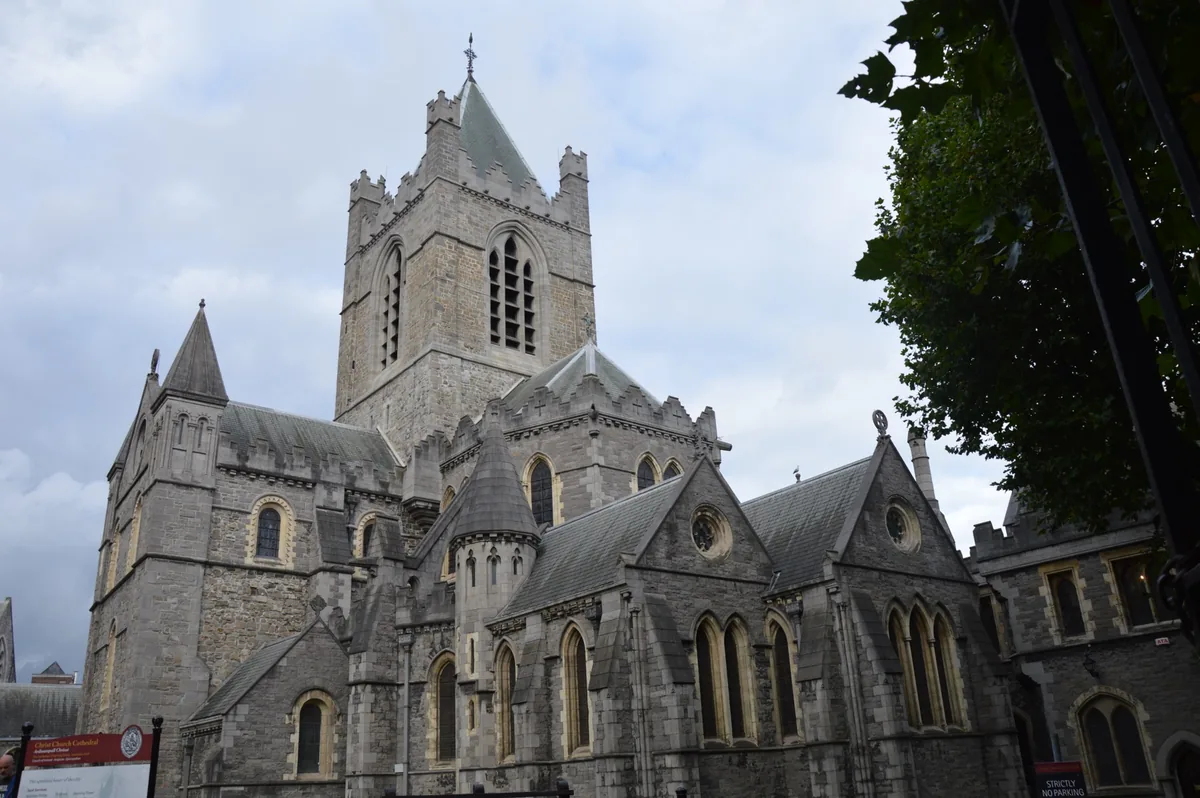
- Type
- Cathedral
- Dedication
- The Holy Trinity
- Diocese
- Dioceses of Dublin and Glendalough
- Built
- early 11th century, rebuilt in stone late 12th century, restored late 19th century
- Style
- Gothic and Romanesque
- Website
- www.christchurchcathedral.ie
Sitric's church and the Norman rebuilding
The cathedral's own history dates a church on this site to about 1030, founded by Sitriuc, the Norse king of Dublin, and Dúnán, the city's first bishop. Wikipedia places the foundation after 1028, when Sitric Silkenbeard made a pilgrimage to Rome, and records that the new diocese answered for a time to Canterbury rather than to the Irish church. The church stood on high ground above the Viking settlement at Wood Quay. By 1152 the see had been brought within the Irish church, and within a decade Laurence O'Toole was archbishop.
In 1163 O'Toole made the cathedral a priory of Augustinian canons, and its prior ranked second in the diocese until the dissolution of the monasteries. After the Anglo-Normans took the city in 1170, Strongbow and other magnates helped to pay for a rebuilding in stone in the 1180s: choir, choir aisles, transepts, crypt and chapels. The cathedral credits John Cumin, the first Anglo-Norman archbishop, with replacing the Norse church by the Romanesque and Gothic building of which parts survive. Most of the surviving nave went up in the 1230s in oolitic limestone from Dundry in Somerset, cut and laid by masons from the same district.
The Reformation and the collapse of 1562
In 1487 the boy pretender Lambert Simnel was crowned in the cathedral as Edward VI, in a bid to unseat Henry VII that failed. Henry VIII abolished the priory of the Holy Trinity by warrant of 12 December 1539, and on 22 December 1541 the last prior, Robert Castle, became the first dean. Since the Irish Reformation the building has been, in law and in practice, the cathedral of the Church of Ireland archbishop of Dublin. The other archbishop of Dublin, in communion with Rome, uses St Mary's in Marlborough Street as his pro-cathedral.
The foundations of the nave rested in peat, and in 1562 they slipped, bringing down the south wall and the stone vault of the roof. The tomb shown as Strongbow's was smashed in the fall, and the present monument is a replacement of the period brought from Drogheda. The north wall of about 1230 survived, and the cathedral says it has leaned outwards by 46 centimetres since. Much of the debris was levelled and floored over, and the emergency repairs stood until the 1870s.
Street's rebuilding, 1871 to 1878
By the nineteenth century the building had been declared unsafe, and Matthew Price carried out limited works between 1829 and 1831. The cathedral dates the disestablishment of the Church of Ireland to 1871 and says that the loss of endowment made lay participation in its governance necessary, so a board of lay and clerical members was formed beside the chapter. In the same year Henry Roe, a Dublin whiskey distiller, undertook to pay for a restoration designed by George Edmund Street. The cathedral puts his gift at £230,000, and Wikipedia says the works cost him in the region of £250,000.
Street worked from 1871 to 1878. He demolished the fourteenth-century long choir and built a new east end over the medieval crypt, rebuilt the tower and the south nave arcade, added flying buttresses as decoration, and replaced the north porch with a baptistry. He also built a synod hall on the site of St Michael's church, keeping its tower, and joined it to the cathedral with a covered stone bridge. The synod hall now houses Dublinia, an exhibition on medieval Dublin, and the cathedral, which receives no state aid, puts its running costs at €1.8 million a year and charges for sightseeing but not for services.
The crypt, the bells, and worship today
Below the church runs the crypt of 1172 to 1173, 63.4 metres long, which Wikipedia gives as the largest cathedral crypt in Britain or Ireland and the cathedral calls the oldest structure in Dublin still in use. In the sixteenth and seventeenth centuries it served as a market, and a letter of 1633 complains that its vaults had been made into tippling houses for beer, wine and tobacco. Restored to mark the year 2000, it now holds the Treasures of Christ Church exhibition, the stocks of 1670, the tabernacle and candlesticks used when James II heard Mass here, and the mummified cat and rat. The tower holds twenty bells, nineteen hung for change ringing, grown from six cast from cannon metal in 1670 to eight under Abel Rudhall in 1738, twelve under John J. Murphy by the 1870s, and twenty in 1999.
Christ Church is the cathedral of the United Dioceses of Dublin and Glendalough in the Church of Ireland, and as the cathedral of its southern province it hosts ordinations of priests and consecrations of bishops. Morning Prayer is said at 10:00 on weekdays, the Eucharist at 12:45 and Evening Prayer at 17:00, and on Sundays the choir sings the Eucharist at 11:00 and Evensong at 15:30 in term, with the bells rung for both. Attending a service costs nothing. The cathedral is dedicated to the Holy Trinity and keeps Trinity Sunday as its patronal festival, which in 2026 fell on 31 May.
Sources
- Christ Church Cathedral, Dublin — Wikipedia (technical facts)
- History of Christ Church Cathedral — Christ Church Cathedral, Dublin, official website (the foundation about 1030, O'Toole, Cumin, Simnel, the 1541 dean, the 1562 collapse, the crypt as market, Street and Roe, the bells, and the crypt restoration for 2000)
- Visiting Christ Church Cathedral — Christ Church Cathedral, Dublin, official website (the crypt as the city's oldest building still in use, Strongbow's tomb, and the mummified cat and rat)
- Hiring the Crypt for Events — Christ Church Cathedral, Dublin, official website (the crypt as the oldest working structure in Dublin)
- Worship and Services — Christ Church Cathedral, Dublin, official website (daily and Sunday service times and free attendance)
- FAQ — Christ Church Cathedral, Dublin, official website (no state aid, admission charges, and running costs of 1.8 million euro a year)
- The Cathedral Eucharist, 31 May 2026 — Christ Church Cathedral, Dublin, official website (the 11:00 Eucharist on Trinity Sunday 2026)
- Choral Evensong, 31 May 2026 — Christ Church Cathedral, Dublin, official website (readings taken from the ecumenical lectionary in use in the Church of Ireland)
- Sermons — Christ Church Cathedral, Dublin, official website (the sermon of 31 May 2026 by Canon Dr Virginia Kennerley)
- Trinity Sunday 2026 sermon — Christ Church Cathedral, Dublin, official website (the Trinity Sunday readings Isaiah 40:12–17, 27–31, 2 Corinthians 13:11–13 and Matthew 28:16–20, and the day as the patronal festival)
Further reading
- Christ Church Cathedral, Dublin: a history — Kenneth Milne (ed.), Four Courts Press, 2000 (borrowable on the Internet Archive)
- Dublin — Encyclopaedia Britannica (the cathedral in the city layout section)